Saturday, September 28, 2013

“This Land” – Exhibition at Salisbury University Galleries, August/September 2013


In 2004, Gochen Tulku Sang-ngag Rinpoche, a Tibetan Lama, was traveling through  Montana when he looked out a car window and recognized something from his dreams:  the massive shapes of mountains floating upon the earth like lotus blossoms on a pond.   From this initial moment of  encounter and inspiration, when earthly elements in the Jocko Valley and the mountain ranges surrounding it conspired to offer a vision to Rinpoche that he reverently embraced, something quite special under the sun has been emerging: a magnificent garden centering on a gold-leafed statue of Yum Chenmo, the Great Mother, a feminine instantiation of Buddha.  Rising two stories above a green meadow with her hands arranged in the mudra expressing the transmission of tradition, the Great Mother’s golden face greets the lotus-shaped mountains with a sublime smile offering limitless compassion and supremely active wisdom.   She in turn serves as the hub for a great wheel with eight spokes emanating from her multi-colored, lotus-shaped seat, each spoke inhabited by two ranks of white Buddhas sitting back to back in unbroken contemplation.  Beyond the rim of the wheel, whose wide arc is composed of innumerable, waist-high stupas, are arranged in the four directions four Buddhas in dark stone, each garlanded daily with freshly gathered blossoms, each gazing back in turn to the figure of Yum Chenmo at the center.  In all, the garden is home to a thousand Buddhas, a river valley and several mountain ranges.  To walk the garden pathways is not only to rediscover the manifold insights of an ancient and venerable religious tradition but also to confront the power inherent in the land here and now to inspire and instantiate that tradition, its aspirations and longings.

‘Land’ is one of those basic words in the English language, serving as a necessary staple, if you will, in our speaking of the world and our place in it.  Indeed, the very notion of finding one’s place in the world only makes sense if there is some land in that place upon which one can set one’s feet. In its most abstract sense, land designates a particular area on the planet’s surface, as long as it is not covered with water. Yet even underneath the waters, land abides, providing the stay by which the waters are upheld.   To simply think of land, then, as a circumscribed area on the planet’s surface trivializes its role in both human and planetary existence.  For we regularly go to war over land, or at the very least, end up in court with unremitting regularity disputing ownership, rights and covenants in regard to land.  And in the American narrative of westward movement, the dignity and freedom offered by land, recommended by Jefferson’s notion of the yeoman farmer and later codified into law through the homestead act, is a decisive and abiding element, for better and worse, of our culture.  Indeed, the very movement westward proved to be a wholesale usurpation of tribal lands of First Peoples, an act whose injustice and violence America has yet to fully admit let alone satisfactorily resolve.  And this latter point reminds us that in land we find concretely and uncannily at play the rights and interests and loves of other humans, indeed of all other humans, not to mention of all other living kinds, whether they be plentiful raccoons or endangered fox squirrels, unwanted poison ivy or the lovely though miniscule blossoms of draba celebrated by Aldo Leopold.

For better or worse then, human cultures have been defining themselves through the land in which they would reside since the beginning of human tenancy upon the face of the earth  As to the worse in our own time,  the gallery viewer might consider Eric LoPresti’s epic yet hellish (the Anglo-Saxon equivalent to the Latinate ‘dystopian’) landscapes, in which clouds of dust stirred up from atomic blasts scour the earth and yet reveal in that very alteration something sublime even if monstrous, something compelling and seductive, even if destructive and apocalyptic.   LoPresti’s work would remind us that not so far from Rinpoche’s beatific garden in the Jocko Valley – in fact, just over the continental divide 60 miles to the east – lies a fleet of minuteman missiles, cocked and ready to fire, ham-fisted weapons with the capacity to annihilate entire cities and indiscriminately poison the soil, water and air surrounding them for generations.  As a child growing up on the high plains in Montana I remember the sudden presence of men smartly appointed in Air Force uniforms explaining the massive construction project that was taking place all around us. One very personable speaker even attempted to ignite with a blowtorch a flake of the solid material fueling the missiles to show us locals how inert and harmless it was, at least until activated with an electronic impulse.  Of course, the nuclear warhead to be installed on top of a tower of that fuel was another matter and remained unmentioned in his talk.  Soon the earth was peppered with underground silos capped by great concrete lids and fenced off from any approach.  Constructed by army-green earthmovers and caterpillar tractors, beautifully graded roads for hauling the bombs and delivery vehicles to their duly appointed resting places appeared overnight stretching across the landscape.  In all of this was an effort not unlike in effect and exceeding by far in economic means that of Rinpoche’s garden: a re-envisioning of what it meant to belong to a human culture by a re-envisioning and reworking of the land upon which that culture makes its home under the sun.  

In viewing  the exhibition ably put together by Liz Kaufman and Marisa Sage, the onlooker might keep in mind the manifold ways in which the very shape and sense of our human existence is constituted by how we come to define our relationship with land and how land inevitably responds in its own way to that gesture.  It’s not just up to us after all.  The land also is apt at making itself know even in our most insistent attempts to turn it into the mere reflection of our own interests and desires.
     
Liz Kaufmann’s curatorial approach asks that the gallery-goer comes to deeper insights not only about the respective practices of artists in their approach to land but also to entertain what one learns from the juxtaposition of these different approaches.   Land is no more fixed in its meaning and possibilities, it turns out, than is the human imagination.   For instance, the epic gestures of LoPresti’s paintings, in which the immensity of planetary surfaces and the primordial forces unleashed in and on them, find an arresting counter-point in the deeply interior landscapes of Kevin Barnes.  In the latter’s work, the light by which tree, meadow or forest is illuminated and so land is revealed in its fullness to the human eye comes from within as much as without.  In his act of painting the land, Barnes would be true to its facts, to its given.  The land has its say.  But at the same time a “distillation” of vision and an intensification of reality takes place in these canvases that find a second life for the landscape in the hypersensitivity of the human mind to color and form.  Magical realism is at work here, although certainly not a magical realism merely introducing fantastic items or elements into an otherwise mundane world.  What is magical, Barnes teaches us, is color and form itself.  And for Barnes the land provides a peculiarly powerful initiation into this magic.


Engaging the land in magical realism of another sort are the photographic performances of Megan Crump.  As with Barnes, the intimacy of one’s contact with the land is paramount.   But in Crump the magical is worked out not so much in color and form, although they have their say, as in personal ritual and shamanistic

transformation.  David Abram, a philosopher who has written tellingly about animistic perspectives on a more-than-human living world identifies the shape-shifting qualities of perception, its metamorphic, protean capacities, as crucial to indigenous frames of mind.  Crump’s photographs work out Abram’s insight by introducing her own body into the land and so into the photographic image she produces of the land.  But this is accomplished so that the very appearance of Crump’s human form tricks the eye, unhinging its assumptions of what might be occurring.  For me a powerful moment of recognition took place when what appeared to be a rather pedestrian fallen tree trunk next to a creek in “Roots” turned out to be Crump’s naked body, carefully arranged to emerge from the undergrowth to appear like a pedestrian fallen tree trunk next to a creek.  In that uncanny and shamanistic transformation, I found myself challenged to see that seeing is itself unhinged by powers at work when land and body become radically open to the possibilities they call forth in one another.


Yet another tack on the role of the land in defining human culture comes in Dan Mill’s “Quest” series, which is composed of abstract portraits of actual maps derived from colonial history.  His paintings invite the gallery-goer to become enchanted yet again with the artifice of map-making, its love of lines and colors as they divvy up the space of a two-dimensional surface.  Indeed, humans of all cultures love maps of all sorts.  Aboriginal painters from Australia, for instance, often transpose traditional maps tracing storylines through country into scintillating fields of color and space on a canvas. But underlying and subverting this enchantment in Mill’s case is the historical provenance of the particular patchworks of color in which he is interested.  The classification and parceling out of land in the history of European map-making has all too often meant the dispossession of others.   The colonial map is a map of discovery that quickly transmutes itself into a map of usurpation.   Indeed, the map in an Air Force file that locates the minuteman missiles scattered about the high plains of Montana overlays a landscape inhabited for some 10,000 years by tribal peoples whose place under the sun has been constricted only since the European arrival to the stingily drawn lines on yet another colonial map defining a so-called Reservation.

Perhaps as well the gallery goer should remember that her or his very footsteps tread the land once part of the Tundotank Reservation of the Wicomico People.  What artwork would be sufficient to register that fact, bear witness to this strange doubled vision of land that is at once home and stolen, at once the land of 
Tundotank and of Tony Tank (a Colonial name derived from the former Native American one) Creek?  Mills leaves that question with us.  And Peter Stern's "Nentego," a mural composed of aerial photographs of land once inhabited by the Nanticoke People takes the gallery viewer one step closer to answering that question, although I cannot imagine, in contradistinction to the artist's own view on this matter, that anywhere on the Eastern Shore a forest unaltered by European incursion remains.


In spite of the historical violence and ecological devastation that is being played out across the surface of the planet, including our own Eastern Shore, the land can still glisten.  And its weathers can still flourish, even if altered in terrible ways by Global Climate Change.  Through the digital arts informed by computer software, data recording and image projection, Mark Nystrom’s alchemical transformation of the winds blowing over the roof of Fulton Hall is not only beautiful in its aesthetic impact but also deeply informative of the remarkable complexity of the wind’s movement, its mercurial gestures with their varying intensities and orientations. All too often the living world has become a vague presence to the denizens of contemporary technocratic culture, who have all too often reduced the earth to a green blur passing by its car windows, or an entertaining flickering of colors and shapes on a computer screen.  But in “Air Current(s)” Nystrom, rather than abjuring the omnipresent technological processing of the living world characterizing our time has challenged himself and his audience to embrace it in a manner that is more rather than less heedful of the land and its many subtle qualities.  Electronically illuminated screens need not always be a way of veiling or blunting our interaction with the elements of land.  They can also uncover truths about it that would otherwise go unnoticed.   In offering the winds for the gallery-goer’s discernment and contemplation, Nystrom’s work is not unlike Gochen Tulku Sang-ngag Rinpoche’s garden mentioned above, which is itself ringed by eight prayer flags perpetually fluttering and falling with the winds.


I am thankful to the curator of this show and the artists included in it for having given me the opportunity to renew my own all too thoughtless relationship with the more-than-human living world.  As these works remind the gallery goer, the land requires much of us if we are to abide heedfully upon it.   While in no way do any of the artists involved in this exhibition advocate for a simplistic nativism, neither do they counsel that we ignore the place upon the earth in which our existence is offered its colors and forms, its depth and meaning.  That enduring and profound struggles emerge in this process, that the outcome is at time times ambivalent and even disturbing does not excuse us from the challenge these works pose for us.    The land is waiting for our reply.


Thursday, December 20, 2012

First People's Buffalo Jump


Buffalo Jump in foreground with Square Butte in background
The First People's Buffalo Jump, the largest of its kind on the North American continent, lies to the west of Great Falls, Montana.  A low lying butte with sandstone cliffs ranging from 10 to 30 feet and extending along three of its sides, this place is revered by all the tribal peoples - Blackfoot, Crow, Salish, Kootenai, Bannock, Nez Perce, Shoshone, Assiniboine, Gros Ventres - who gathered together and hunted in this area long before the arrival of Europeans.  Richard Hopkins, the affable and visionary director of the State Park preserving this site, explained to me how the rich soils deposited on the high prairie surrounding the Jump during the last ice age sustained grasses having an unusually high protein content.  The harshness of the weather and the lack of trees may not remind a current day observer of the biblical paradise, but in many senses these rolling hills were one.  Immense herds of bison, along with a coterie of their predators, including coyotes, grizzlies and wolves, flourished here.  And humans too.  

At the Jump, the stories involving buffalo and humans lie buried 6000 years deep.  In ravines carved out by seasons of rain and snowmelt, one can sometimes spy weathered bones returning to the light after a long sojourn in the earth.  As I followed the paths lacing the hills below the cliffs on a cold October day, I came to realize the very earth upon which I stood was built up from the once living bodies of buffalo now resting below my footsteps. And not only buffalo died here.  Humans too continually risked their lives to hunt buffalo during what are called "the dog years" by tribal elders, the years before the horse entered into the world of tribal peoples.  Hunting buffalo before the horse was a dangerous activity that required all the tribal peoples of this area to work closely together.  As a result, the Jump is still acknowledged as a place in which a great power resides, the power of peace and survival, a place where the intertwined stories of Buffalo and humans were lived out and now reside.  Even if the bison have departed, their stories and so their spiritual presence on the face of the earth remain palpable here.

But in our time and place, the bison have departed.  By the end of the nineteenth century only two thousand remained.on the entirety of the North American continent.  Once they had numbered in the tens of millions. As I walked along the path overlooking the cliff face, I felt a peculiar loneliness.  For here precisely where the stories of bison reside most powerfully in the Montana landscape, no living animal was to be found.  This disjunction is a painful one, a persistent reminder that this place under the sun, even as it remains sacred, has been subjected to immense violence, to a genocidal impulse that flooded over the high prairie during the last two centuries with the the arrival of my European kin, their guns, their booze and their railroads. Even today a minuteman missile silo housing a nuclear payload just a mile or two down the road from the Jump site is a powerful reminder of the modes of life dealing in death that still persist here. Yet today a resurgence in the numbers of bison is also afoot.  One walks these hills hoping that in the not too distant future, buffalo will again graze the grasses and keep company with the prairie dogs living on the top of the butte.  What a story that would make.


Sunday, November 18, 2012

Monoculture on a Pilgrimage Route

 
These cedars on the Kumano Kodo pilgrimage route near Chikatsuyui Japan have always struck me as particularly beautiful, precisely because they grow in such preternaturally straight lines.  As a result the energy of the mountainside seemingly bursts upwarded unimpeded to the heights.  It is as if one is witnesing uninhibited enlightenment.  And the landscape bordering the Kumano Kodo is for Shingon Buddhists preeminently an exemplar of Buddha mind.   

Does it matter then that these trees are also textbook examples of monoculture, cedars arranged in straight rows supplanting the rice paddies that once were cultivated on this terraced mountainside?  The forest is managed to eliminate scraggly trees and undesirable competitors.  Is not then this grace deeply flawed? 
 
And still I am moved. 

Thursday, October 25, 2012

Tjilpa Dreaming

A joint post by Deborah Bird Rose and myself on attempts to address the endangered Western Quoll in Australia's Red Center: http://extinctionstudies.org/communications/tjilpa

Thursday, September 20, 2012

Extinction for Sale

Lot 1304: Extinct Passenger Pigeon
Lot 1304: Extinction for Sale

As Janet Laruence herself tells it, one of the roots of her approach to the living world in the artwork is found in her residency early on in her career at a natural history museum.  Surrounded by specimens - mammals, insects, lizards and otherwise - she was deeply touched by their presence, by how their having lived a particular and unique existence was memorialized in the very bodies now preserved in drawers, specimen jars or through the arts of taxidermy. After a time, she found herself talking to the various creatures whose remains were her daily companions.  She reports  the welling up in her of tenderness, of loving kindness, of care-taking for the once living.  This affection inhabits Memory of Nature and her many other sculptural works.

For Laurence specimens themselves pose a host of ethical and ontological issues.  One in particular struck me the day we were visiting in her studio.  Janet explained that she had "rescued" the preserved owls (I cringe at using the word "stuffed" here) that make periodic appearances in her installations.  They were items in an auction that included a variety of preserved animals, particularly birds.  Janet felt immediately she had to save at least some of these from becoming yet again mere items in collections.  She wanted to give them a home in her studio and so bid successfully on the group of owls she now owns.

As I leafed through the catalogue that Laurence had kept from that auction, I noticed several items were of extinct species, including the one pictured here of a passenger pigeon.

My reaction to seeing the passenger pigeon for sale and commanding a large opening bid, precisely because it was extinct, made me cringe.  As Janet pointed out, the original impetus for specimen collecting - knowledge, however questionable its status might be - had become peculiarly perverted here.  The body of a bird whose kind is now extinct had become a fetish, an object inflaming human desires to own it, precisely because humans had wiped out its kind..

This left me with a question I will take up with in further posts: What human obligations might there be in regard to the bodily remnants of a species wiped off the face of the earth by humans?  What mode of respect or tenderness is called for when one confronts a specimen of a passenger pigeon?  Should it even be subject to a notion of ownership, given the circumstances of its current earthly (non)existence?  And precisely what is this pictured above?  A specimen?  A monument?  A corpse?  An outrage?  An opportunity for bragging rights?  A blasphemy? A spiritual instruction?

Wednesday, September 5, 2012

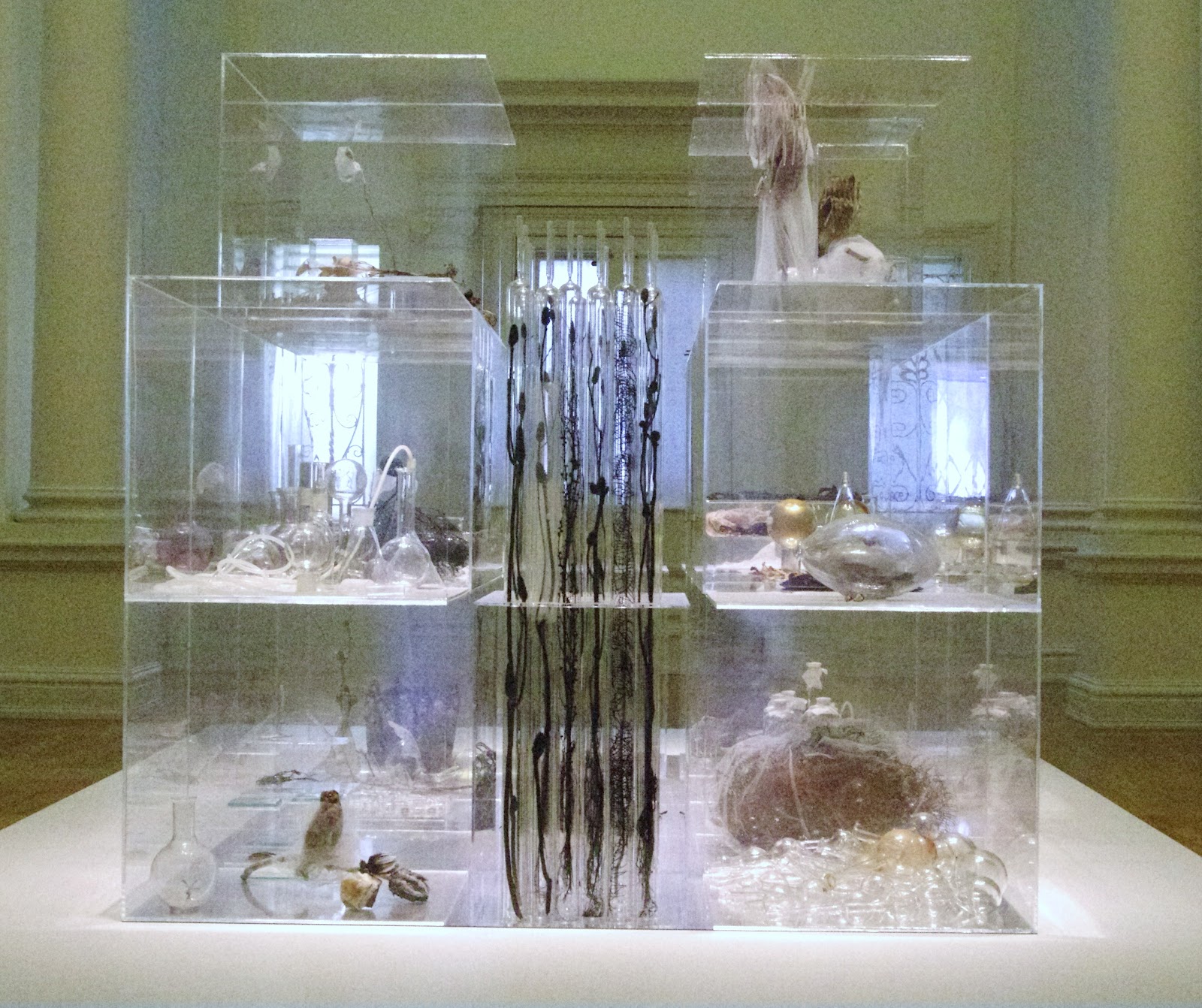
Janet Laurence's Memory of Nature


Memory of Nature at NSW Museum of Art in August of 2012


The complexity of Janet Laurence's sculptural installations, both semiotically and perceptually, is dizzying.  Her oeuvre poses repeatedly the question of how the diverse elements of nature might find their way into our all-too-often, only-too-human capacities and habits of knowing and perceiving.  This has been particularly true of a recent series of works that has included Waiting: A Medicinal Garden for Ailing Plants and After Eden.  So too with her Memory of Nature, which I visited several times at the New South Wales Art Museum during early August of 2012.

A strong elegaic quality permeates Memory which has led curators to characterize it as "a memorial to nature now lost."  But the presence of nature, even aspects of nature that are profoundly in danger of  being wiped off the face of the earth, is actually more to the point in Laurence's approach to her subject.  Her works are inhabited by a loving tenderness for the living world, which, we are called to acknowledge, inevitably is also the dying world, indeed, the world become dead.  Memory reminds its viewer how the distance between the unborn in the womb and the recently living being rendered back into earthly elements is not so far.  Laurence would have human-beings enter into the liminal space between death and life, not in order to renounce earthly existence and all its chthonic mysteries, but in order to become fully acquainted with it and them.

Memory of Nature: Side View
One dimension of Memory has to do with the arts of collecting, caring for and preserving specimens. Memory itself is a multiplex specimen box, crammed with specimen jars of various shapes and sizes, some of which are empty and many of which are filled with objects: thistle seeds, burnt bones, dried branches, mounted insects, mounds of sulfur, whatever.  Memory reminds us, gives us again a mind to understand, that a specimen bottle need not remain a cold and abstract tool but might also become a mode of engaging in a relationship with the once living. The specimen bottle, she reminds us forcefully, is also a tomb.  And so Memory is both specimen box and hallowed resting place, indeed a specimen box of specimen bottles, a graveyard of tombs.  One senses that for Laurence, this artwork, as well as the museum in which it finds itself, is as much a mortuary as anything. One is reminded that the development of the art gallery was intertwined early on with that of the natural history collection.  Her works reenact the Wunderkammern, the cabinets of curiosity of Renaissance nobles, for whom the collecting of odd things, of the finest and the strangest, expressed a passion to interrogate and be interrogated by the natural world.
 
Looking into a Well of Reflection
But Memory also transforms the paraphernalia of preservation into light and so into image.  As one looks into the manifold of glass boxes housing the various objects collected for viewing, one finds these at first seemingly inert specimens are also being transformed into a bewildering maze of reflection and counter-reflection, all of this intensified by the placement of mirrors on the bottom layer of the installation.  Memory is an image machine.  Entering into it, one's gaze is directed downward into a well of reflection, as each object and then each layer of objects is transposed into a virtual space possessing indefinite depths and fostering unexpected juxtapositions.  After a time, one also experiences how one's fellow humans are inevitably brought into this play of  light as the various gallery goers circulating around the piece are also reflected into it.  It is as if one is looking into a Leibnizian monad, a unique particle that simultaneously carries all aspects of the world outside it also within its bounds.  One is reminded as well of Laurence's favorite philosopher--Maurice Merleau-Ponty--who argues that very nature of the living body is already to be interwoven, interlaced, with every body surrounding it.  In the act of perception, all living bodies, human or otherwise, find they are outside of themselves in order to be within themselves.  As a result, the notion of the envelope body, of an inert mass contained within and by an explicit surface, turns out to be an abstraction, a mere residue, of the lived and perceiving body that is the envelope body's progenitor.  Exploring the relationship of envelope body to lived body, Laurence's Memory asks its viewer to consider anew the very manner in which she or he is a body. 

Gaze to Gaze with the Owl
One corollary to Merleau-Ponty's notion of a lived and perceiving body is that the body that is gazed upon is also a body that gazes back. One finds this insight at work in Memory. As one's gaze wanders into this maze of reflection, one registers that the work also has its own gaze and, indeed, is gazing back.  This occurs in part through the placement within Memory of a series of owls (which will get their own blog later) preserved by the arcane arts of taxidermy and purchased by Laurence at an auction. Their gaze--or is it merely a simulacrum of a gaze?--confronts the gaze of the viewer, returns it. Indeed, the owl's gaze not only confronts the gaze of the viewer passing by but also that very confrontation of gaze with gaze confronts my gaze.  I look upon the other (a viewer) looking upon another (the owl) who is in turn returning the viewer's look with one of its own. Memory reminds me my gaze is already an interweaving with the gazes of others--both within and without the artwork.  I am also asked to consider how the gaze of a preserved owl has an ontological status quite different from that of a painted owl.  Indeed, the sculpture has been arranged so that the largest owl looks out onto a nineteenth century landscape painting, one in which a hillside has been denuded of trees. The juxtaposition of the bodily remains of an owl, a creature who once actually flew through the forest night in search of prey, with the painted image of a forest provokes one among many passages of what I term semiotic destabilization in Memory.

Anthropologist and cultural critic Deborah Bird Rose (who is pictured gaze to gaze with the owl above) visited Memory with me one afternoon.  She  remarked on how it, as well as other installations by Laurence, inspires a quiet and prayerful attitude in its viewers. And, sure enough, each gallery goer, as they entered into the room where Memory was located, would alter her or his demeanor.  Conversations stopped as viewers would draw near in contemplation.  I thought of how the overall shape of Memory was reminiscent of an altar.  But  Deborah's point was not that the sculpture made a reference to being an altar but actually was one, and that human viewers could sense this.  The altar that was also Memory communicated reverence and remembrance in regard to both the fragility and the fecundity, the timidity and the ferocity, of the earthly.  I am thankful for that.

Monday, August 27, 2012

Thicket

Thicket of River Gums at Fowlers Gap
"Art can never match the luxury and superfluity of Nature.  In the former all is seen; it cannot afford concealed wealth, art is niggardly in comparison."
- Henry David Thoreau

All too often our shared public sense of the earth is defined by  the world opened up in an image, by all the crap--leaf litter, fallen branches, rotting trees, ravenous mosquitoes and the rest--transformed into harmonious color and pleasing shape.  And so, we bring nature into our cultural existence through the iconic artwork.  But for Thoreau the directness in these works of art, that they seek from the beginning to reveal in one manner or another what is significant (even if that significance is manifested as a significant absence) in the scenes set before an audience is deceptive.  For whatever secrets a work of art might hold, they are nothing compared to those of nature.  As Heraclitus famously observes, nature hides; it does not manifest itself readily, if ultimately at all. But nature's holding secrets doesn't mean it necessarily appears deeply mysterious and compelling to the human eye, as if one were hovering over a swamp of primordial ooze from out of which ghostly creatures emerged fulgurating into a slightly more palpable existence. That's a romantic version of secrets.  And perhaps one version of the biblical account as well, the one before the one in which the Most High must dirty her or his fingers in the mud to get the work of creation accomplished.  Thoreau's notion of secretive nature is not romantic, even if it is often mistakenly thought so .  For Thoreau at first glance the natural world often appears dowdy and scrappy, scant and thin, in a word, disappointing.  And this precisely is its virtue.    

Thickets can be like that.  Upon being entered, they surround one so immediately, so inopportunely, that one  can't even get a vantage to see what's going on around one.  One's very body feels dislocated, arms and legs akimbo as branches push one's head in one direction while a thorn pricks one's cheek and suggests quite forcefully another path is needed.   The near and the far become cryptic and indecipherable.  In a thicket, that peaceful globe of vision, in which a world leisurely blossoms forth from a discernible horizon, collapses and withers.  The effortlessly attained vistas that are offered up to our gaze as we walk upon an earth contoured for our own immediate needs prove to be Baconian idylls of perception.  Finally, nature makes clear it does not desire an audience but our participation.  It wants us, body and soul.

Thus the image now sitting demurely at the head of this entry proves to be a performative contradiction.  For certainly it seeks, through aspiring to be artful, an audience for a moment undergone in my habitation of a dry riverbed, one wintry desert evening a few months back in Australia.  Amidst eucalypts, mulga and saltbush the artist found, before a thicket, an open space affording the luxury of exploring a thicket without being overcome by it.  Perched outside, the camera looked in and discerned how, in the impenetrable, rhythms and  shapes still abound.  In doing so, the image feeds my addiction and yours as well to see the world from afar, of our holding nature together in a single glance.  There is no photography, is there, without a focal length?

So how might I offer a defense of this simple act of bringing nature into an image, given Thoreau's objections?  This is to ask anew in what manner might the image play a positive role in our participation in the secretive domain of nature.  My next blog entry will turn to a recent artwork by environmental artist Janet Laurence to develop this question.